
Friction Stir Welding (FSW): Technology and Applications
Friction Stir Welding (FSW) is a transformative solid-state technology that solves long-standing challenges in joining lightweight, dissimilar, and hard-to-weld materials. With its high quality, low distortion, eco-friendliness, and automation compatibility, FSW has become a core manufacturing process in aerospace, automotive, rail, shipbuilding, and electronics industries—driving innovation in lightweight design and sustainable manufacturing.
FRICTION STIR WELDING(FSW)
SHINSHENG TECH Admin
1/30/20263 min read
Friction Stir Welding (FSW): Technology and Applications
1. Basic Definition & Core Principle
Friction Stir Welding (FSW) is a solid-state joining technology invented by TWI (The Welding Institute) in the UK in 1991. Unlike conventional fusion welding (e.g., arc welding, laser welding) that melts base metals, FSW joins materials in a thermoplastic solid state—no melting occurs during the entire process.
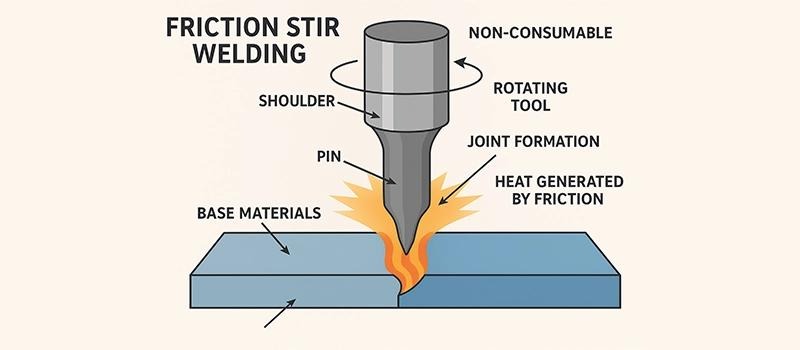
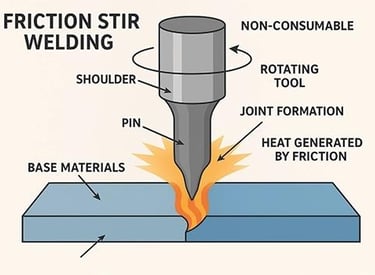
The core principle relies on a non-consumable rotating tool with two key parts: a profiles probe (pin) and a shoulder.
Step 1: Plunging – The high-speed rotating mixing head (probe + shoulder) is pressed vertically into the joint of the workpiece until the shoulder makes tight contact with the workpiece surface.
Step 2: Plasticizing & Stirring – Friction heat generated by the tool’s rotation raises the temperature of the metal at the joint, softening it to a thermoplastic state (below the melting point); The rotating probe drives the plasticized material to flow and mix vigorously, filling the gap in the joint.
Step 3: Traversing & Forging – The tool moves at a constant speed along the direction of the joint, with the shoulder continuously applying axial pressure to forge the plasticized material behind it; upon cooling, this forms a dense, pore-free, high-strength solid weld.
2. Key Advantages Over Fusion Welding
Superior Weld Quality – No porosity, cracks, or inclusions; uniform microstructure and high joint strength (often matching base metals); narrow heat-affected zone (HAZ) with minimal softening.
Low Distortion & Residual Stress – Low heat input avoids severe thermal expansion/contraction; ideal for precision components and thin sheets.
Excellent Material Compatibility
Light Alloys: Perfect for aluminum (1xxx–7xxx series), magnesium, copper, and titanium—materials prone to cracking in fusion welding.
Dissimilar Metals: Enables reliable joining of Al–Cu, Al–Mg, Al–Steel, etc.—a major challenge for fusion welding.
Hard Metals: Weldable stainless steel, carbon steel, and high-strength alloys (with specialized tools).
Eco-Friendly & Safe – No arc radiation, spatter, or toxic fumes; no need for shielding gas, filler wires, or flux; low energy consumption (≈30% of arc welding).
High Efficiency & Automation – Single-pass welding for thicknesses 0.3–75 mm (aluminum); easy integration with CNC, robots, or gantry systems for mass production.
3. Industrial Applications
3.1 Aerospace
Aircraft Structures: Welding of aluminum alloy fuselages, wing panels, fuel tanks, and landing gear components—delivering lightweight, high-strength, and airtight joints.
Spacecraft & Rockets: Critical parts like cryogenic fuel tanks (aluminum–lithium alloys), rocket motor casings, and satellite structures benefit from FSW’s low distortion and high reliability.
3.2 Automotive & New Energy Vehicles (NEVs)
EV Battery Systems: Battery trays (aluminum extrusion / plate welding), cooling plates, and enclosure housings—requiring high conductivity, leak-tightness, and structural rigidity.
Body & Chassis: Aluminum door panels, roof rails, engine cradles, and suspension components—reducing vehicle weight by 20–30% for better fuel efficiency.
Other Parts: Motor housings, DC/DC converters, and airbag gas generators.
3.3 Rail Transportation
High-Speed Trains: Welding of aluminum alloy side walls, roof panels, and undercarriage components—ensuring structural integrity and fatigue resistance under dynamic loads.
Metro & Light Rail: Large aluminum extrusions for car bodies and connection of dissimilar metals (Al–Steel) for lightweight design.
3.4 Shipbuilding & Marine Engineering
Hull & Deck Structures: Welding of aluminum alloy hulls, superstructures, and bulkheads—resisting corrosion and reducing maintenance costs.
Offshore Platforms: Aluminum leg structures, living quarters, and piping systems.
3.5 Electronics & Thermal Management
Cooling Systems: Liquid-cooled cold plates for power electronics (e.g., inverters, servers), heat exchangers, and 5G communication equipment—providing uniform heat dissipation and leak-tight seals.
Consumer Electronics: Aluminum housings for laptops, mobile phones, and tablets—achieving seamless, high-strength joints.
3.6 Other Industries
Electrical Engineering: Copper busbars, transformer windings, and electrical connectors—leveraging FSW’s high conductivity and crack-free joints.
Defense & Military: Armored vehicle components, missile casings, and naval equipment.
4. Weldable Materials & Joint Types
4.1 Common Materials
Non-Ferrous: Aluminum alloys (most widely used), magnesium alloys, copper & alloys, titanium & alloys.
Ferrous: Carbon steel, stainless steel, high-strength low-alloy (HSLA) steel.
Dissimilar Combinations: Al–Cu, Al–Mg, Al–Steel, Ti–Al, etc.
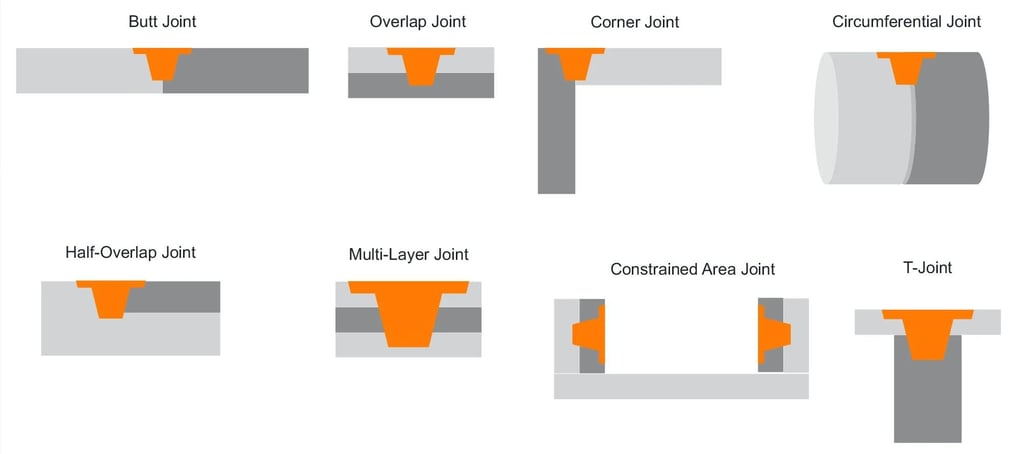
4.2 Typical Joint Geometries
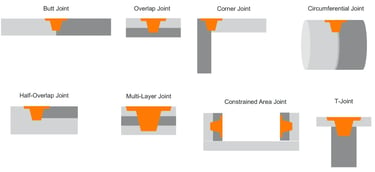
Butt joints, lap joints, T-joints, corner joints, and fillet joints—suitable for sheets, extrusions, and complex 3D components.
5. Limitations & Considerations
Tool Wear: High hardness tools (e.g., tungsten-based, PCBN) are required for welding steel/titanium, increasing costs.
High Axial Force: Requires rigid clamping and machine rigidity (critical for thick materials).
Joint Accessibility: The tool’s shoulder size limits access to narrow or confined spaces.
6. Summary
Friction Stir Welding (FSW) is a transformative solid-state technology that solves long-standing challenges in joining lightweight, dissimilar, and hard-to-weld materials. With its high quality, low distortion, eco-friendliness, and automation compatibility, FSW has become a core manufacturing process in aerospace, automotive, rail, shipbuilding, and electronics industries—driving innovation in lightweight design and sustainable manufacturing.
SHINSHENG TECH
SHINSHENG TECH service portfolio: automotive precision stamping tooling, plastic injection mold, die-casting mold &related parts; linear motor &frameless torque motor; filtering material &air/water/oil filter; ODM/OEM and customized services.
© 2026 SHINSHENG TECH. All rights reserved.
Quick links
Get in touch
Address
Community 40, Fuxing Road, Haidian District, Beijing, China