
Selection of Spring Materials
SPRING
SHINSHENG TECH Admin
11/19/20251 min read
Selection of Spring Materials
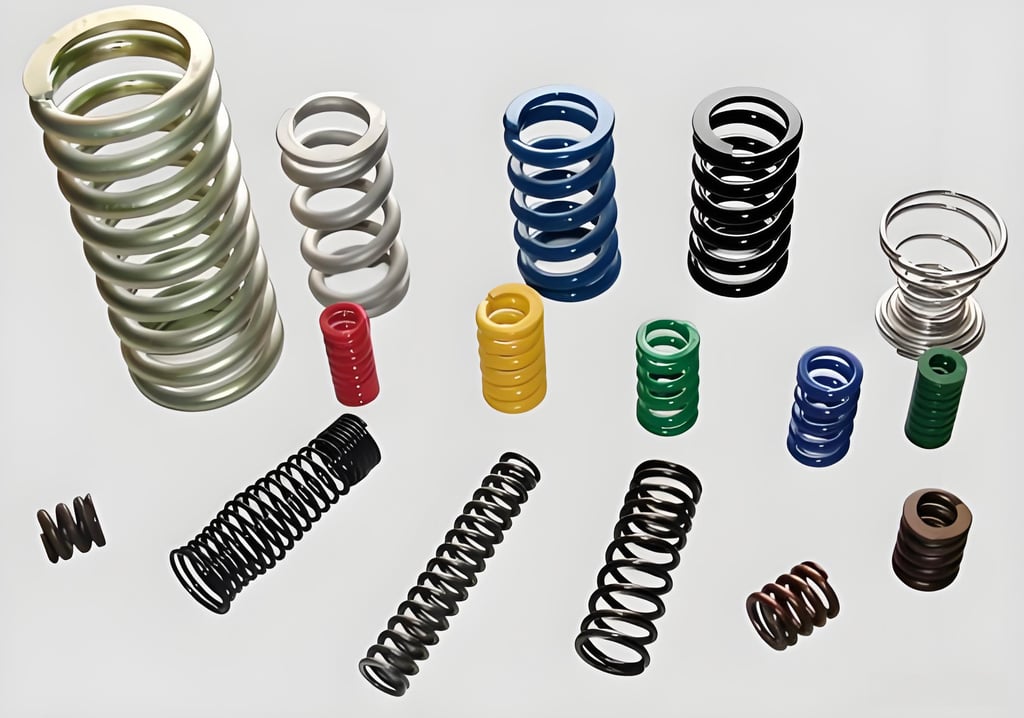
The selection of spring materials should be determined based on factors such as the nature of the load the spring bears, the stress state, the magnitude of stress, operating temperature, environmental medium, service life, requirements for electrical and magnetic conductivity, processability, material availability, and cost.
When determining the cross-sectional shape and dimensions of the material, priority should be given to using series dimensions specified in national and ministerial standards, avoiding non-standard series specifications whenever possible.
For medium and small springs, especially helical tension springs, prioritize using wire that has undergone strengthening treatments, such as lead-bath isothermal cold-drawn wire and oil-quenched and tempered wire. These offer higher strength, superior surface quality, and better fatigue performance than ordinary quenched and tempered wire. They also feature simpler processing, good workability, and stable quality.
Carbon spring steel wire and music wire develop significant residual stresses after cold drawing. When fabricated into springs, these residual stresses remain substantial, leading to considerable dimensional changes after tempering and making dimensional accuracy difficult to control. Oil-quenched and tempered wire undergoes tempering treatment after drawing to specified dimensions, leaving virtually no residual stress. Springs formed from this wire exhibit minimal dimensional change after low-temperature tempering and superior thermal stability compared to cold-drawn hardened wire.
For medium to large springs requiring high load accuracy and stress levels, cold-drawn material or cold-drawn and ground steel should be selected. For springs with lower load accuracy and stress requirements, hot-rolled steel may be used.
SHINSHENG TECH
SHINSHENG TECH service portfolio: automotive precision stamping tooling, plastic injection mold, die-casting mold &related parts; linear motor &frameless torque motor; filtering material &air/water/oil filter; ODM/OEM and customized services.
+86 136-2119-0931
© 2026 SHINSHENG TECH. All rights reserved.
Quick links
Get in touch
Address
Community 40, Fuxing Road, Haidian District, Beijing, China